


The church of the nativity is visited by hundreds of thousands of people each year and is the most visited place in Palestine. Christian pilgrims from many faiths come to see the place where the Christ child was born. In the Manger district of Bethlehem, one of the oldest churches on the planet still stands. It has a fascinating history and has been spared numerous times.
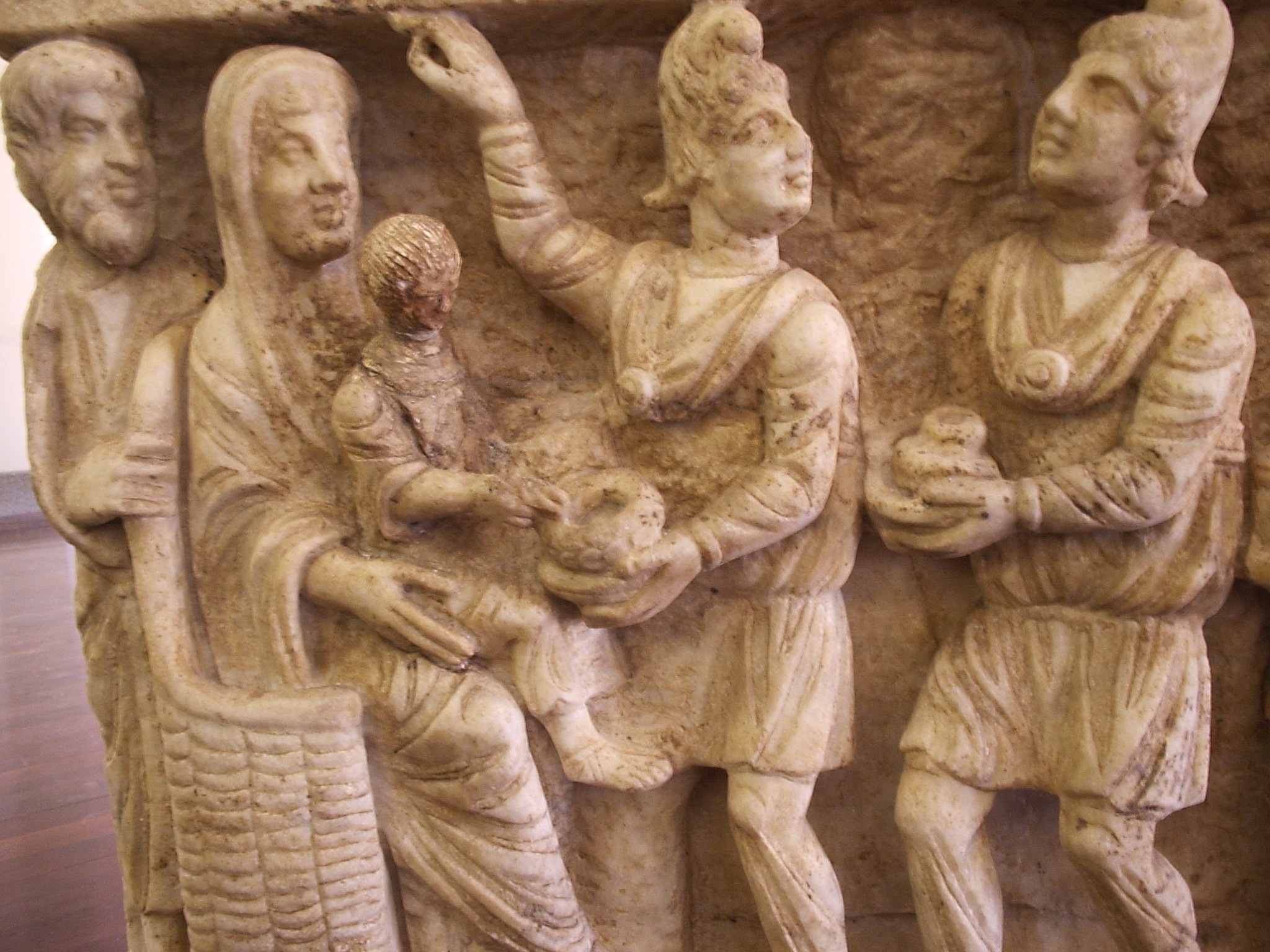
3rd Century Sarcophagus (courtesy Wikipedia)
They say a Persian mosaic in the floor kept the Persian army from destroying the church. The floor in the church has a lower floor, be sure to look down into the original floor. It has been built up and reconstructed on different occasions. The columns of the church are incredible, but don’t forget to go downstairs to the most important part and the reason the church was constructed where it was…


The entrance of the church is most unusual. A 4 foot door entry makes you imagine a small little church, but in reality it is a large church, but not the size of the basilicas in Europe. This column is of John the Baptist or Baptizer, the one to prepare the way.


The picture of the stable and the manger as being the birthplace of Jesus is a picture which is indelibly etched in our minds; but it may well be that that picture is not altogether correct. Justin Martyr, one of the greatest of the early fathers, who lived about A.D. 150, and who came from the district near Bethlehem, tells us that Jesus was born in a cave near the village of Bethlehem (Justin Martyr, Dialogue with Trypho, 78, 304); and it may well be that Justin’s information is correct. The houses in Bethlehem are built on the slope of the limestone ridge; and it is very common for them to have a cave-like stable hollowed out in the limestone rock below the house itself; and it is very likely that it was in such a cave-stable that Jesus was born.
To this day such a cave is shown in Bethlehem as the birthplace of Jesus and above it the great Roman Church of the Nativity has been built. For very long that cave has been shown as the birthplace of Jesus. It was so in the days of the Roman Emperor, Hadrian, for Hadrian, in a deliberate attempt to desecrate the place, erected a shrine to the heathen god Adonis above it. When the Roman Empire became Christian, early in the fourth century, the first Christian Emperor, Constantine, built a great church there, and that church still stands. H. V. Morton tells how he visited that Church of the Nativity in Bethlehem. He came to a great wall, and in the wall there was a door so low that even a dwarf would have to stoop to enter it; and through the door, and on the other side of the wall, there was the church. Beneath the high altar of the church, there is the cave, and when the pilgrim descends into it he finds a little dark cavern about fourteen yards long and four yards wide, lit by fifty-three silver lamps; and in the floor there is a star, and round it a Latin inscription: ” Here Jesus Christ was born of the Virgin Mary.”

Above: The location of the holy family. Marked by three lamps in the Church of the Nativity in Bethlehem.

Above: Star marks the spot of the birthplace of Jesus. The newborn king.
According to Christianity, a group of distinguished foreigners who visited Jesus after his birth, bearing gifts are regular figures in traditional accounts of the celebrations of Christmas and are an important part of the Christian tradition.
The Gospel of Matthew, the only one of the four gospels to mention the Magi, states that they came “from the east” to worship the Christ. The three gifts make many assume there were three kings.
Matthew 2:1–12 describes the visit of the Magi:
In the time of King Herod, after Jesus was born in Bethlehem of Judea, wise men from the East came to Jerusalem, asking, “Where is the child who has been born king of the Jews? For we observed his star at its rising, and have come to pay him homage.” When King Herod heard this, he was frightened, and all Jerusalem with him; and calling together all the chief priests and scribes of the people, he inquired of them where the Messiah was to be born. They told him, “In Bethlehem of Judea; for so it has been written by the prophet: ‘And you, Bethlehem, in the land of Judah, are by no means least among the rulers of Judah; for from you shall come a ruler who is to shepherd my people Israel.'” Then Herod secretly called for the wise men and learned from them the exact time when the star had appeared. Then he sent them to Bethlehem, saying, “Go and search diligently for the child; and when you have found him, bring me word so that I may also go and pay him homage.” When they had heard the king, they set out; and there, ahead of them, went the star that they had seen at its rising, until it stopped over the place where the child was. When they saw that the star had stopped, they were overwhelmed with joy. On entering the house, they saw the child with Mary his mother; and they knelt down and paid him homage. Then, opening their treasure chests, they offered him gifts of gold, frankincense, and myrrh. And having been warned in a dream not to return to Herod, they left for their own country by another path.
Encyclopædia Britannica states: “according to Western church tradition, Balthasar is often represented as a king of Arabia, Melchior as a king of Persia, and Gaspar as a king of India.” These names apparently derive from a Greek manuscript probably composed in Alexandria around 500, and which has been translated into Latin with the title Excerpta Latina Barbari.[8] Another Greek document from the 8th century, of presumed Irish origin and translated into Latin with the title Collectanea et Flores, continues the tradition of three kings and their names and gives additional details.
“The first [magus or wiseman or magician], named Melchior, was an old white-haired man, with a full beard and hair: the king gave gold to our Lord.” The second, with name Caspar, a beardless boy, gave incense. The third one, dark-haired, with a full beard, named Balthasar… gave myrhh. “The clothes of all [three] were Syrian-style.”
Is it possible that these wisemen each represented each of the sons of Noah? Ham – Africa/Ethiopia, Shem – Europe Persia, Japeth – India/China Asia
Who were these Magi, and where did they come from? Apparently the word Wisemen in the translation of the bible is magnus or magi which comes from Zoroastrian tradition from Persia.
Their supposed relics were transferred from Constantinople, possibly in the late 5th century, to Milan and thence to Cologne Cathedral in the 12th century. Devotion to the Magi was especially fervent in the Middle Ages. The Magi are venerated as patrons of travelers; their feast day is July 23.


Above: Left: Dom Cathedral in Köln (Cologne) Germany Right: The ceiling of the basillica

Today, the bodies of the magi are in the Cologne Cathedral where they are venerated as saints and called the “Three Kings of Cologne.” In Germany their feast day is July 23. They have become the patron saints of travelers. In fact the names have been engraved on rings to prevent cramps and objects have been touched to their skulls and worn to prevent accidents.

Relics attributed to them emerged in the 4th century and were transferred from Constantinople to Milan in the 5th century, and then to Cologne in 1162 where they remain enshrined. Shrine of the 3 Kings in Dom in Cologne Germany. Courtesy: wikipedia
Where did the Magi come from?
In recent tradition the Magi have been portrayed that one each of the three kings, or noble men, originated from:
- Western Europe (usually Celtic-like from the British Isles or France)
- African (usually Abyssinian or Ethiopian), and
- Asia either from the Arabian Peninsula (e.g., Yemen or Oman)
- Far East (usually China).
The European is often portrayed with the gold as the other two gifts were native to Africa and Asia, so the myrrh and frankincense vary by King.
In contrast in historical tradition, the Syrian Christians name the Magi Larvandad, Gushnasaph, and Hormisdas. These names have a far greater likelihood of being originally Persian. In the Eastern churches, Ethiopian Christianity, for instance, has Hor, Karsudan, and Basanater, while the Armenians have Kagpha, Badadakharida and Badadilma. Many Chinese Christians believe that one of the magi came from China.
Persian?
“Since the days of Daniel, the fortunes of both the Persian and the Jewish nation had been closely intertwined. Both nations had, in their turn, fallen under Seleucid domination in the wake of Alexander’s conquests. Subsequently, both had regained their independence: the Jews under Maccabean leadership, and the Persians as the dominating ruling group within the Parthian Empire.
It was at this time that the Magi, in their dual priestly and governmental office, composed the upper house of the Council of the Megistanes (from which we get the term “magistrates”), whose duties included the absolute choice and election of the king of the realm.
It was, therefore, a group of Persian–Parthian “king makers” who entered Jerusalem in the latter days of the reign of Herod. Herod’s reaction was understandably one of fear when one considers the background of Roman-Parthian rivalry that prevailed during his lifetime.” Who were the Magi By Chuck Missler
More on the Three Kings Day in Puerto Rico: The History and Meaning of Three Kings Day in Puerto Rico.
the “12 Days of Christmas,” which is so often believed to end on December 25, actually begins on the 25th and runs through January 6, culminating with the Feast of Epiphany, or “The Adoration of the Magi.”
How many magi?
- a painting in the cemetery of Sts. Peter and Marcellinus shows two;
- one in the Lateran Museum, three;
- one in the cemetery of Domitilla, four;
- a vase in the Kircher Museum, eight (Marucchi, “Eléments d’archéologie chrétienne”, Paris, 1899, I 197).
- The story from China 12.
- What was the star?
Various theories have been presented as to what this phenomenon refers to, since stars do not visibly move and therefore cannot be followed. Some believe that they followed a planet, which without a telescope could be mistaken as a star, as it slowly moved across the sky
- The word aster may mean a comet; the star of the Magi was a comet. But we have no record of any such comet.
- The star may have been planets or a conjunction of Jupiter and Saturn (7 B.C.), or of Jupiter and Venus (6 B.C.).
- The Magi may have seen a stella nova, a star which suddenly increases in magnitude and brilliancy and then fades away.
- In Ethiopian tradition the star was an angel in the sky which led them to the manger “About the year 6 B.C., the long awaited star appeared. It shone brightly in the shape of a beautiful boy child with a cross glowing behind him. The star-child announced, “The King of the Jews is born in Judea. Go quickly to worship him.””
Lost Manuscript and Revelations of the Magi
Brent Landau, professor of religious studies at the University of Oklahoma, spent two years translating an 8th century copy of a story that was written about 100 years after the Gospel of Matthew written in Syriac. It is written by from the perspective of the wise men… and not three, but sixty. This translation was just published as The Revelation of the Magi, which Professor Landau believes to be a firsthand account of their journey to pay homage to the Christ Child.
“The fragile manuscript is actually an eighth-century copy of a story which was written down hundreds of years earlier, less than 100 years after the Gospel of Matthew was written. What the Magi saw was the Star itself. “It transformed into a small luminous human being,” he said, “who was Christ Himself in a pre-existent, celestial form. The star guides them to Bethlehem and into a cave where it transforms into a human infant who tells them to go back and be preachers of the Gospel.”
Persian Stories of Fire worshipping linked to the Magi/Magicians/Wisemen
http://www.farsinet.com/wisemen/magi.html
Appears some of the folk story is still coming together…
Information on the church converted from a temple by the wise man in Urumia
In the comments on this article there’s a reference to a Zorastrian temple turned church
I was told by a local person that the ancient structure was not a church, rather it was a Zorostrian temple. One of the 3 wisemen who visited new born Jesus was a Zorostrian Priest who after the crucifixation started practising Christianity & converted the temple to the christian church.
Dr. N. D. R. – worked in Kerman Province
I really enjoyed this translation from Marco Polo – one of my Hero’s in Travel. I see a lot of irony in the fact that the translation was updated in Koln Germany based on what I mentioned prior… that the wisemen are believed to be entombed in the Cathedral Dom in Koln.
Marco Polo on Persia’s “Christian” fire worshippers
From Chapter XI (Of the province of Persia) of Marco Polo’s “The Travels; The Description of the world” written in 1298. This translation is by William Marsden, revised by Thomas Wright (Konemann Travel Classics, Koln, Germany, 1996). I fixed 5 words which were misspelled.
Persia was anciently a large and noble province, but it is now in great part destroyed by the Tartars. In Persia there is a city which is called Saba, from whence were the three magi who came to adore Christ in Bethlehem; and the three are buried in that city in a fair sepulcher, and they are all three entire with their beards and hair. One was called Balthazar, the second Gaspar, and the third Melchior.
Marco inquired often in that city concerning the three magi, and nobody could tell him anything about them, except that the three magi were buried there in ancient times. After three days’ journey you come to a castle which is called Palasata, which means the castle of the fire-worshippers, and it is true that the inhabitants of that castle worship fire, and this is given as the reason.
The men of that castle say, that anciently three kings of that country went to adore a certain king who was newly born, and carried with them three offerings, namely, gold, frankincense, and myrrh: gold, that they might know if he were an earthly king; frankincense, that they might know if he were God; and myrth, that they might now if he were a mortal man.
When these magi were presented to Christ, the youngest of the three adored him first, and it appeared to him that Christ was of his stature and age. The middle one came next, and then the eldest, and to each he seemed to be of their own stature and age. Having compared their observations together, they agreed to go all to worship at once, and then he appeared to them all of his true age.
When they went away, the infant gave them a closed box, which they carried with them for several days, and then becoming curious to see what he had given them, they opened the box and found in it a stone, which was intended for a sign that they should remain firm as a stone in the faith they had received from him.
When, however, they saw the stone, they marveled, and thinking themselves deluded, they threw the stone into a certain pit, and instantly fire burst forth in the pit. When they saw this, they repented bitterly of what they had done, and taking some of the fire with them they carried it home.
And having placed it in one of their churches, they keep it continually burning, and adore that fire as a god, and make all their sacrifices with it; and if it happen to be extinguished, they go for more to the original fire in the pit where they threw the stone, which is never extinguished, and they take of none other fire. And, therefore, the people of the country worship fire.
Marco was told all this by the people of the country; and it is true that one of those kings was of Saba; and the second was Dyava, and the third was of the castle.
Ethiopians worshiped him
In Ethopian tradition they believe it was for told from the prophets that they would visit. This blog has a number of references and stories relating to the Ethiopian connection of the wisemen who visited baby Jesus. “The Three Wise Men were Ethiopian.”
Experpt from Psalms 72: 9-11; 15
9 They that dwell in the wilderness shall bow before him; and his enemies shall lick the dust.
10 The kings of Tarshish and of the isles shall bring presents: the kings of Sheba and Seba shall offer gifts.
11 Yea, all kings shall fall down before him: all nations shall serve him.
15 And he shall live, and to him shall be given of the gold of Sheba: prayer also shall be made for him continually; and daily shall he be praised.
They were said to come from the kingdoms of Tarshish, Sheba and Seba. Seba was thought to be an ancient name for Ethiopia, and in the 14th century the Ethiopian king began to be portrayed as black.
Ethiopia (and especially the Ethiopian Orthodox Church) still use the old Julian calendar, so they celebrate Christmas on January 7th, not December 25th! The Christmas celebration in the Ethiopian Orthodox Church is called Ganna. Most people go to Church on Christmas day.
Many people fast (don’t eat anything) on Christmas Eve (January 6th). At dawn on the morning of Ganna, people get dressed in white. Most people wear a traditional garment called a shamma. It’s a thin white cotton piece of cloth with brightly colored stripes across the ends. It’s worn like a toga.

Archaeologists and historians have tried to discover the origin of the Magi. One modern write, Prof. A.V. Gutschmidt, tried to place the wise men as coming from Persian provinces but admitted that he was not quite sure. Many other commentator vaguely state that these wise men were “from the east.” Hans Holzer in his book Star of the East states that one of the magi was emperor of Ethiopia. He also named them Caspar, Melchior, and Balthasar- Caspar as king of Afghanistan, Melchior as a ruler in the Near East, and Balthasar as King of Ethiopia. An article written by William Leo Hansbury and E. Harper Johnson concerning the wise men identified them as Caspar, king of Ethiopia, Melchior, king of Nubia, and Balthazar, king of Saba. There is a contradiction between Hans Holzer and these other two writers. However, Holzer, who believes the name Bazan gradually became Balthazar (Balthasar), seems closer to the truth. Aleqa Taye, an Ethiopian historian, writes, “King Bazan ruled Ethiopia for 17 years, eight years before and nine years after Christ.” The Ethiopian Tewahedo Church: “The Wise Men and the Nativity of Christ” p. 9-11
Prof. August Dillman, in his book Royal Ethiopia lists Ethiopian rulers from the time of the queen of Sheba to the last period of King Bazan. He also states that during the eight years of the reign of Bazan, Christ was born. The archaeologist discovered the tomb and relics of King Bazan and his family in Axum in 1904. From this he concluded that Bazan lived in the first century A.D. The inscription on the tomb was in Sabaean. Thus the king who worshiped Christ was Bazan, emperor of Ethiopia. This was the fulfillment of the prophecy of 68:31, “Ethiopia shall soon stretch forth her hands unto God.”
Indian Folktale
In exchange for their expensive gifts, Mary gave the wise men some of the swaddling clothes in which Jesus had been wrapped. She also gave them a little box with a stone in it. The stone was supposed to remind them that their faith ought to be as strong as a rock. Mary must’ve neglected to tell them that because, thinking this stone was worthless baggage, the wise men tossed it into a well. Whereupon fire from heaven filled the well. The amazed wise men carried the fire back to their own country and built a magnificent cathedral around it so that the people could worship it. Later, they were baptized and, giving all their possessions to the poor, they went about living a life of poverty and preaching the Gospel of Peace until their martyrdom in India.
A legend states that St Helena, mother of the first Christian emperor Constantine, discovered the bodies of the wise men/kings in India in the in the 330s and took them to Constantinople (present day Istanbul). Her son gave them to the Bishop of Milan. In the 1160s the Holy Roman Emperor, Frederick I Barbarossa, brought their bodies to Cologne in Germany.
Modern Traditions Wise Men Bring Gifts to the Children…
In Spain and much of Latin Western Christianity celebrates the Magi on the day of Epiphany, January 6, the day immediately following the twelve days of Christmas, particularly in the Spanish-speaking parts of the world. In these areas, the Three Kings (“los Reyes Magos de Oriente“, also “Los Tres Reyes Magos” and “Los Reyes Magos“) receive letters from children and so bring them gifts on the night before Epiphany. Each one of the Magi is supposed to represent one different continent, Europe (Melchior), Asia (Caspar) and Africa (Balthasar). In some countries children leave their shoes out and toys or candy may be left. Grass, Hay or Straw may be left in the shoes for the wise men’s camel.
Celebrations of the 3 Kings or Wise men are celebrated all over the world
In Puerto Rico, I had the priveledge of being able to participate in one of these celebrations… ironically it’s a sponsored celebration by Coke.


“December 25? For some Puerto Ricans, that’s merely a prelude to what they feel is really the important day of the marathon Christmas Season in Puerto Rico. I should point out that the Three Kings, or Los Reyes Magos, are not only venerated in Puerto Rico but throughout the Latin World.”
Read more about “Three Kings Day in Puerto Rico .” I highly recommend that as one of two dates of the best days to be in Puerto Rico. The other best day is a day where the people wear masks, kind of like Halloween in July.


